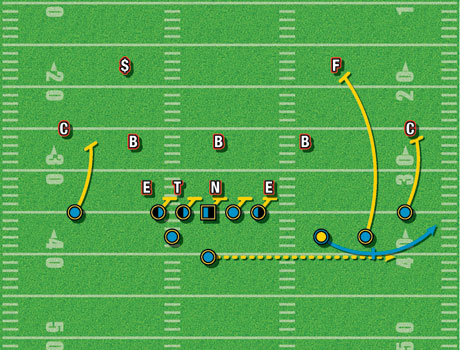
Wichita State in the late 1970's, was looking for an "equalizer" to help them be competitive with schools that were bigger, faster, and stronger. The staff there sat down and came up with what we know as the midline option. Of course true triple option teams such as Georgia Tech and Navy run the midline option, but it is starting to be implemented by more teams in both high school and college that would not be considered true option teams.
Advantages of the midline:
1) The tight mesh of the QB/FB serves as a means to freeze the linebackers to give the offensive linemen a half step advantage 2) Forces DTs to close one of two gaps 3) Collapses the defensive front 4) Allows option football to be ran to the short side of the field 5) Allows a dominate DT to be "read" instead of having to be blocked 6) Hits quickly 7) Minimizes chance of lost yardage play 8) Easiest of all the veer reads
How to block midline:
The following two diagrams show how midline is blocked versus a 4-2/4-4 look. For information on blocking midline versus odd fronts, visit the different links in the resources section at the bottom.
As you see in the diagram above, the QB is reading the 3 technique DT for a give or keep read. If the DT gives him a keep read, the QB will then key the SAM linebacker. He will pitch the ball to the back if the SAM closes inside.
In this diagram, the QB's pitch key has changed from the SAM linebacker to the DE. As mentioned, this scheme takes advantage of an over aggressive OLB playing the QB. The pull and pitch on this play can be very "bang, bang", so repping the pull and pitch process with your QB is vital. At the 0:10 mark, you can see Navy running this exact scheme vs. Notre Dame.
Instead of using the remaining back as a pitch guy, some prefer to lead the back up on the outside linebacker/most dangerous defender instead of pitching off of him. This turns the play from a triple option to a double option. Here is a clip from The University of Charleston where instead of using the motion back as a pitch guy, he leads up for the QB carrying the ball.
The following two videos feature Muskegon (MI) High School and their midline game out of their spread pistol formations:
How often as coaches have we said or thought, "how can this be that hard"? Or, "I don't understand why he can't see that"? I believe one common mistake we make as coaches is we always assume our kids understand what we're teaching, unless they express is some way that there is confusion. I assume most of you reading this blog coach football. We eat, sleep, and breath football. We often times forget that football probably isn't near as important to the kid you're coaching as it is to you. Things aren't as simple to the kids as they are to us. Also, we as coaches don't have to worry about the physical aspect of performance. It is a lot easier to see what is going on from the sidelines or the press box when you're not the one being rushed or blitzed.
I'm going to steal the example used by QB guru Darin Slack, that compares a typical quarterback's understanding to an iceberg. What the quarterback understands is symbolized by the part of the iceberg that is above the water. Now, let's look at what you, the coach, understands. That is symbolized by the entire iceberg, both what is above and below the water. How do we get our quarterbacks to understand the entire picture, see the entire iceberg?
There are a lot of things on the quarterback's plate: receiving the playcall from the sideline, relaying the playcall to the other 10 guys, checking to make sure everyone is aligned properly, checking the front, counting the safeties, checking the corners, looking for potential blitzers, mentally reviewing his technique and read on the forthcoming play, and all of this while keeping an eye on and beating the 25 second clock. That is a checklist of 10 things a QB is responsible for...PRE-SNAP. After the snap, the job is even more difficult as he's trying to drop, go through a progression, and make the proper throw while bullets are flying all around him. Without question, quarterback is the most challenging position on the field. In my opinion, it is the most demanding position in all of sports. All of these things are on our QBs' plate, and that doesn't take into account the physical performance aspect of the position.
Football is a gray game more often than it is a game of black and white. What do I mean by that? Well, let's say you are running a typical curl- flat concept to stretch an OLB. You tell the quarterback, "if the OLB drops throw the flat, if he runs to the flat throw the curl." Here's the problem with that logic; you are assuming there are only two things the OLB can do. What if the OLB hangs in the balance between the curl and the flat? Well coached defenders are very good at slow playing their responsibilities and making a "cloudy" read for the quarterback. Also, that school of thought doesn't consider if a robber technique safety or a deep dropping inside linebacker getting in the curl window. Let's say a robber technique safety jumps the curl and makes an interception. The kid comes over to the sideline and says, "coach, you told me if the OLB jumps the flat to throw the curl." He did what you as a coach told him to do. As coaches, we sometimes are guilty of making this game black and white when it is in fact a very gray game in the eyes of our quarterback.
Quarterbacking is indeed a different animal and a position unlike any other. It only makes sense for quarterbacks to be trained unlike any other position as well. Welcome, the R4 QB Expert System. The R4 system is a product of The Darin Slack Quarterback Academy and Jenks (OK) passing game coordinator Dub Maddox. Coach Maddox describes it as a "powerful system of QB reads, recognition and decision-management. A system that accelerates passing game progressions, defender keys, and disciplined footwork in any offensive scheme." Some people make the mistake of assuming this is an offensive system. That is definitely not the case, but it is a system that can take the offensive system you already have in place to a level you hadn't seen.
Here is a trailer video from Coach Slack's website that provides an overview of what R4 is and how it can help your program achieve the goals that are set:
Brian Blevins, the head coach at Kettering Fairmont High School in Ohio talks about how the R4 has taken his quarterback and passing offense to a whole new level.
Let me say, I am writing this endorsement for the R4 system not because I'm being asked to or because I'm trying to drive business to a friend. I wrote this because I believe in the system and believe it will help your quarterback reach a level of play he's never been to before. You can purchase the 3 DVD set R4 QB Expert System here and start training your quarterbacks on their reads and recognition in a new and effective way.
As always, check out Chief Pigskin.com for lots of great videos and articles that will help improve your program.
When some people hear the terms "zone read" the term "innovative" may come to mind. When some hear the terms "inside veer" they may think "archaic" or "outdated". However, when dissecting these two plays, they are very similar and even blocked exactly the same way in some instances.
Nevada, #1 rushing team in the FBS last year makes it's living off of the inside zone read. While Georgia Tech, the 2nd ranked rushing team in the FBS made a good chunk of its yardage off of inside veer. When breaking down these plays, they seem more like identical twin brothers than an than products of different generations. The inside veer has made a comeback in college football, as many spread teams are using variations of it to create a numbers and angles advantage for their offense. Both the inside zone read and inside veer feature one or two guys being "optioned", combo blocks, and both number and angle advantages at the point of attack.
The play in the following video shows Nevada's patented inside zone read out of the pistol. Missouri is playing what looks to be a shade nose or 1-tech and a 5-tech on the left side. The guard and center will combo the A-gap defender up to the backside linebacker and the tackle will release to the MIKE linebacker. Nevada gains an extra blocker on the perimeter by bringing the wing around to block the OLB in case of a pull read by the QB. You'll notice the DE closes on the dive like most coaches will teach in defending option football. The QB pulls the ball and is out on the perimeter, with a 1 to 1 blocker to defender ratio.
In this clip, you see the inside zone read ran to the side of the 3-tech and 5-tech. The guard and tackle work a combo block, to get the 3-tech sealed and the guard releases on an inside track to the MIKE linebacker. Again, the DE takes his dive responsibility and Nevada is out on the perimeter with good numbers.
Now, let's take a look at one of the staple plays in Paul Johnson's flexbone repertoire, the inside veer. On the left side, Georgia appears to be playing a 3-tech and a 7-tech. Much like the second clip of Nevada's inside zone, you'll see a combo working from the 3-tech up to the MIKE linebacker. The DE is of course the man being optioned, just like in the inside zone read.
In the following clip, Georgia lines up with what looks like a head up zero technique. The center scoops the nose and the guard and tackle release up the field to the play side linebacker.
In this last clip, inside veer is ran to the 1-tech and the 5-tech. Just like in the first clip of Nevada's inside zone read, the guard will combo with the center on the 1-tech and work to the backside linebacker. The playside tackle releases to the OLB.
As you can see, the plays are blocked nearly identical at the point of attack, but differ depending on where the combos are taking place. For insightful video on inside zone schemes, check out this video and others at ChiefPigskin.com
For more information on installing inside veer as a part of your offense, check out the following sites:
In the last part of this series, we will look at the fly/jet sweep as a way of getting the ball in the hands of your playmakers. This concept uses the lateral motion rule to it's advantage in getting the ball to a player who already has momentum built up. The fly sweep is a concept that seems to be catching on at all levels, from youth football all the way up to the NFL. It's a simple means of getting the football to the perimeter of the defense to one of your best players. I could spend several posts talking about all the different way to run this play, but it is just my intent to provide you with a basic overview and provide some resources/video to learn more about the play.
When to run the fly sweep:
Like the bubble and tunnel screen, the fly sweep is a simple and sure fire way to get the football to a guy in space that can make something happen. Also, if you're hurting a team with your base run scheme between the tackles, most likely they will adjust to that by doing something such as pinching their DEs to take away the b-gap run game, etc. Running the fly sweep is a great way to take them out of that scenario and loosen up the core of the defense. Obviously, we want at least a stalemate or a man advantage when it comes to blockers vs. defenders on the perimeter.
Blocking:
When the fly sweep was first introduced, it seemed to be strictly an outside zone/reach scheme on the offensive line. However, since it's become popular, many have played with the blocking schemes to fit their offensive philosophy and scheme. For example, Bryon Hamilton at Foothill High School in California runs what he calls the "Shotgun Zone Fly Sweep"; which he created to fit how he wanted to block the fly sweep. It features a combination of both man and zone schemes. Coach Hamilton has based his entire offense around the fly sweep, and you can read more about it here. Below, I've provided some video to show you some different ways in which the fly sweep is blocked.
In the following two clips, Oregon is running what appears to be counter trey and inside zone away from the fly sweep and reading the DE on whether to give to the sweeper or have the QB keep the ball and run the counter or zone.
The University of Charleston, uses what appears to be a reach and overtake scheme towards the fly sweep. For a great drill to teach reach blocking, check out this video from ChiefPigskin.com.
The following clip is a digital playbook from East Valley High School, created by coach Ayinde Bomani; which shows in detail how they block their fly sweep. They choose to block it using what appears to be outside zone rules.
Much like the bubble screen, which was the focus of Part 1 of this three part series, the tunnel screen is another simple and effective way to get the ball to your home run hitters. This screen is also called the jailbreak screen by many. At Liberty High School, the tunnel screen has been one of our most successful plays for us over the last 2 years.
When to throw:
Like I mentioned in the intro, this is a great play to get your explosive guys touches just to increase the probability of a big play. It can be thrown versus both man and zone coverage. It can be thrown versus a one high safety look, or a two shell look. The tunnel screen, like all screens, is one of the best blitz beaters out there. If you've got a good tunnel screen game, then a defensive coordinator is going to be very careful of when and when not to bring heavy pressure. Like the bubble screen, you want to make sure you have a numbers advantage on the perimeter to the play side.
Blocking:
I've seen the tunnel screen blocked a few different ways. Some teams release their playside tackle, while others don't. Some teams use a count system to identify who they are responsible for, while others just run to an area and pick up the most dangerous man. At Liberty High School, we use a count system to identify who each person will block. We will number from the sideline in to determine who each receiver and offensive linemen will block. The guy directly inside of the receiver catching the ball is responsible for #1, which in most cases will be the corner. The next guy to the inside will be responsible for #2, which is usually the force player. The next guy inside, will be responsible for #3, which is often an inside linebacker. The video below is a clip of Texas Tech's tunnel screen. You will notice that the #2 receiver is responsible for the corner. They chose to not release their tackle to keep the defensive end working up the field, so the guard is responsible for #2. The center is responsible for #3, which is the MIKE backer in this case. However, he follows the back on his fake and takes himself out of the play, so the center continues to climb to the safety.
You can play with the schemes according to how you see fit. For example, if we see that a corner is playing at 12 yards and bailing at the snap we will not count him and send the guy responsible for #1 to a safety or double on the force player.
The offensive line will pass set and count "one one thousand, two one thousand", then release up the field. A key coaching point on this is having them release to where their defender is going to be, not to where he is at the moment. The receivers involved in the blocking, will release up the field two steps to sell a dropback pass and then work to the defenders they are responsible to block. If there is a press or hard cover 2 corner, then a flat release is necessary.
We only release the play side of our offensive line, however some teams choose to release both sides in order to gain a decisive numbers advantage down the field. Texas Tech shows the full release of the offensive line in the video above.
Receiver:
The receiver's steps can be played with to fit the timing of both the quarterback and the blocking. We teach the receiver to take one hard step up the field, and then work back to the quarterback while also gradually working downhill towards the line of scrimmage. You can see this in the video above, but the receiver has to stop his momentum toward the LOS because the ball is thrown to his back shoulder instead of his upfield shoulder. Again, you can play with the angle and the receivers steps to fit your scheme.
Quarterback:
Because this is a delayed screen, you have a lot of freedom in what you want your quarterback and backfield to do before the QB delivers the ball. We've done many different things, to provide a variety of looks and to maximize deception. One of the things we did was have the QB from the gun take 3 steps, while looking the safeties and linebackers to the other side of the field, then delivering the ball on the upfield shoulder of the receiver on the third step. If under center, we would take a 5-step drop and deliver to the receiver on the 5th step. Another thing we've done is fake to the back coming across, which is done in the clip above. Finally, one element we added this past season was a half sprintout or roll to the opposite side and then throwing back to the receiver. This helped to get flow going the other way, before delivering the ball. Like I mentioned above, the timing of the screen allows you a lot of freedom to fit your backfield action into your offensive philosophy. The videos below will show you some variety in of backfield action. One important coaching point for the QB is to throw the ball to the receiver's upfield shoulder so he does not have to slow his momentum to catch the ball. This could be the difference between a 12 yard gain and a huge play. In the video above, if the ball was thrown on the upfield shoulder of the receiver it would have increased the chances of getting by the safety that makes the tackle.
Video:
In the videos below, you will see some different ways to run the tunnel screen.
Please check out Chiefpigskin.com for great videos and articles that will provide you with awesome insight for all aspects of the game.
When it comes to getting the ball on the perimeter to your playmakers, the bubble screen is as good as it gets. If you're a coach that charts touches to make sure you're getting your explosive players enough opportunities, this play provides a very easy method of getting the guys you want the football in space. In the past five or so years, this play has become a vital scheme in almost all spread offenses.
When to throw?
The bubble screen is generally thrown to an inside receiver that is lined up off of the ball, when the offense has a numbers advantage to a certain side on the perimeter. This play takes advantage of an outside linebacker that is cheating in the box to gain a numbers advantage in the box for the defense. In the diagram below, the offense considers themselves to have an advantage because of the outside linebacker to the trips side could still be considered an in-box defender.
Blocking:
Generally, the bubble is blocked using an outside zone, reach, or cut technique from the offensive line. The ball is out of the quarterback's hand so quickly that the offensive line's objective should just be to keep the defensive ends from shooting upfield quickly to hinder the throw or keep them from being able to run flat and possibly make a play on the ball. On the perimeter, a simple stalk technique works and the receiver can read the blocks. If it provides better angles, cracks and cross blocking can be done as well. Another way it to reach the outside shoulder of the defenders, turn them inside and have the receiver look to get up the sideline.
Receiver:
There are different techniques used to put the receiver in good position to run after the catch. I will explain the technique that we use at Liberty High School. The slot receiver (whether it is #2, #3, or #4) should align with his inside foot up and the objective on his first step is to gain more depth than width. Depth is important because we want the receiver to be catching the ball while running towards the line of scrimmage. Using the clock analogy, a good step for him would be to take his back foot to the 5 or 7 o'clock mark depending which side he is on. The receivers second step would be parallel to the line of scrimmage, and on his third step he would turn his head and look for the football while working back towards the line of scrimmage at roughly a 45 degree angle (halfway between parallel and perpendicular) to the line of scrimmage. The ball should be to him on his fourth or fifth step. In the videos below, you will see two different techniques used that are also very effective.
Quarterback:
Contrary to the tunnel screen (which will be addressed in the next post) where you see different fakes by the QB and different backfield action, the bubble does not leave a lot of room for creativity by the QB because of the ball needing to be in the hands of the receiver quickly. In the second video below, you will see some fakes to a back to get flow going away from the play and to improve the angles of the blocks. The quarterback should aim to put the football on the 12-18 inches in front of the receiver running towards the line of scrimmage.
Shotgun or Under Center?
The bubble works effectively both under center and in the shotgun. Both provide an advantage the other one does not. Under center, the ball is able to get to and out of the quarterback's hand quicker than in the gun. However, in the gun you are throwing the ball forward to the receiver instead of risking a fumble by throwing it backwards. Not completing the pass simply results in an incomplete pass instead of a backwards lateral, which is a live ball.
Videos:
In the videos below, you will see clips of the bubble screen at both the high school and the college level. Many of the coaching points discussed above can be seen, however these teams do some different things as well.
Thanks to Brethren Christian High School in Huntington Beach, CA for the video of their bubble screen game.
My alma mater, the University of Missouri also utilizes the bubble screen as a big part of their offense. The video below has several clips of their bubble screen in their bowl game vs. Navy.
Further and complete reading on the bubble screen:
This is my first entry as a featured blogger for http://www.chiefpigskin.com. Coach Nate Albaugh has lots of great stuff on his site and I'm glad to be associated with a site such as that dedicated to helping football coaches.
The term "robber" means different things to different coaches. Some coaches play a form of cover 2 robber, while "robber" to others is a man-free scheme designed to spy a QB that is a running threat. In this post, I'm going to focus on cover 2 robber. This defense was designed to stifle the 2-back power run game by getting nine defenders involved in stopping the run. Like all coverages, it has some vulnerability but when defending a 2-back, run heavy offense there is nothing better.
Other advantages of Robber: 1. Able to get FS to both sides of the ball. 2. Able to get control of #2 deep on any vertical routes. 3. Lets inside LB play run because #2 is always controlled vertically to TE side. 4. Able to use 5 DB’s as a base package, which gives better team speed. 5. It looks like cover 3, cover 1, and cover 0 pre-snap.
Cover 2 robber is a form of invert cover 2, with the OLBs/outside safeties being the curl-flat players and the corners playing a deep half like safeties would be in traditional cover 2. The FS is the "robber", in which the coverage is named after. He will serve as the 9th defender in the run game or be a pass defender, depending on his run/pass read. The FS will read the #2 receiver to the "passing strength", if he goes vertical then he will run with him and play a man technique. If #2 runs to the flat, he will then look to "rob" any inside breaking route from #1 such as a curl or dig. If #2 runs an inside breaking route such as a shallow, the FS's eyes will look for a crosser from the other side or look to help with #1. An important key is not disrupt the routes, but to let them develop so the reads can be made with clarity.
If he gets a run read, then he will fly down into his run fit, providing that 9th defender in the run game. Of course, his fit can be any where in the run game that fits the scheme you're employing.
We could spend all day talking about alignment, run fits, coverage responsibilities and reads for the back 7 guys. However, I'm not a defensive coach and it is my intent to just provide a basic overview of this coverage. If you want to learn more, I recommend visiting Coach Huey's great site and interacting with the great resources on there, which is linked on the right side of the page. Also, the legendary Brophy has a blog post which features TCU's defensive playbook that outlines what they're teaching in their cover 2 robber. To access that, click here
The video below is from Virginia Tech's win in 2008 over Georgia Tech. Because of the run heavy triple option philosophy of Georgia Tech, Virginia Tech played a lot of cover 2 robber to get a 9th defender involved in the run game. You'll see the very first snap, the FS gets a run read and makes the tackle for a 2 yard gain. The second snap, the FS gets a pass read with #2 going vertical. There you see him run with #2 in a man technique. Throughout the video, you will see the FS making his reads and being heavily involved as a run game defender.
 As you see in the diagram above, the QB is reading the 3 technique DT for a give or keep read. If the DT gives him a keep read, the QB will then key the SAM linebacker. He will pitch the ball to the back if the SAM closes inside.
 In this diagram, the QB's pitch key has changed from the SAM linebacker to the DE. As mentioned, this scheme takes advantage of an over aggressive OLB playing the QB. The pull and pitch on this play can be very "bang, bang", so repping the pull and pitch process with your QB is vital. At the 0:10 mark, you can see Navy running this exact scheme vs. Notre Dame.